This is the evaluation of the performance; I believe that the show went well even though a few mistakes were made. Unfortunately I was one of the people who made mistakes, I forgot my lines two times and there were a few seconds of silence, however luckily I did not come out of my character and I remained focused. Even though I couldn't remember the line I remembered the trace of my characters thought in that moment. I forgot my lines in the part where Thea is telling Hedda about her relationship with Eilert. my line was about how Eilert made thea feel alive and cared for. So i improvised it but still went along the bases of my line. During rehearsal I found it difficult to know when to come on stage, this was because we were outside of the room; we couldn't hear our ques. However instead of trying to listen for my ques instead I looked out for body language and movement from other characters. My queue was when Hedda got up and walked down stage left near the corridor. I would then come in but not straight onto stage, I would be in the corridor as thea and be waiting to enter the house of eilert and hedda.
I was very surprised that I forgot my lines on stage, because not once did I forget them in rehearsals on that day, honestly I probably did better in rehearsals then on stage. I feel a reason as to why I forgot my lines is that i was concentrating too much on what to say next rather than living and being in the moment. For a tiny second I knew what I had to say but then I just lost it and it went out of my head, but like i said before luckily i had an idea in my head of what my character was feeling at that moment.
I found the exercises we did before the show helpful as well, One of the excersies were to pick one line from the play that had the biggest intention on effecting another character, this highlighted to me that This was my major wham line which has to be said with the most conviction.
Also during the performance my friend said a line too early and missed out the bit where he was supposed to ask me for eilert's address. so I stepped in and said "Here I think yout might want to take his address"That action i did did not change the flow of energy, it kept the energy on stage keep going.
From this performance i've realized that plays can never fully be finished as there is always something that you can do to change it and I've learned you will never know how well a performance can go until you are performing
Tuesday, 13 October 2015

Applying techniques
I have done some research into Stanislavsky's techniques to see the different types of techniques he has created and to find out How i could apply them to my character work, I discovered one of his techniques; Physical actions- it is said if it is arranged in a certain order (e.g the order could be building up tension) it can provoke the necessary emotions in the actors performance.
Because I am playing the character of Thea and she is very "mouse" like i portray that in my body language, so i always make my self look small, I never open up my body in the scene. My hands are always together, fiddling with my fingers, My shoulders are never fully dropped low, there is always a form of tension in then, they are slightly perked up nearer to the middle of my neck. If I have to sit down in the scene I am very hesitant about it. Or if i choose to sit down I would never lounge out on the seat, my legs would always be very closely together.
If I physically make my self look small this will have an effect on my emotions, I wouldn't feel comfortable or relaxed, which is definitely how Thea is feeling, she feels anxious that she is in the house of hedda and tesman, because she has some little secrets that she doesnt want to reveal such as how her husband didn't know that she was coming here; to heddas house.
Again by me physically moving around the stage, taking small little steps in the space, makes me feel nervous, which is true. Normally when you are nervous you cant keep still, it is as if like you are trying to search for safety or reassurance. So because I know taking small steps around the space provokes these emotions I choose to move around the space when Hedda is confronting =/ integrating Thea about her relationship with Eilert and her husband. This is how I applied Stanislavsky's physical action technique to my rehearsal process.
Emotional Memory requires that an actor recreate an event from the distant past in order to regenerate the ‘feelings’ experienced at that time. These feelings thus regenerated are then used in the current acting situation in order to fill out the role with ‘human depth and personal involvement’ (Benedetti 66). The necessity of the event being from the distant rather than recent past is because Stanislavski felt (at that time) that time distilled events and feelings, acting as a ‘splendid filter for remembered feelings.’ Stanislavski believed that the quality of the actor’s performance depended upon the sincerity of his experience. This sincere experience went through a ‘time filter’ that transformed the quality of the experience into a ‘poetic reflection of life’s experience’ (Stanislavski quoted. in Moore 42). On stage the actor lived, not a real life, but a true stage experience.
From this, one can gather that stage emotion is not the same as emotion in life, because as Stanislavski put it, on stage it is a ‘repeated’ experience, not a ‘primary’ one. The actor can stir the needed emotion in him/ herself by remembering a parallel situation having a similar emotion. This emotion would then need to be brought out at the exact moment when called for on stage. This ‘evoking’ of past experience was called ‘Emotional Recall.’ Thus, through rehearsal and training techniques, the actor developed a conditioned reflex.
In the play, I find it hard to relate to some things and therefore if i cannot relate to them I cannot put my emotional memory into practice for example. asking someone to write a letter for me, however for the things I can relate to, emotional memory plays a big part in it. Especially when Hedda confront Thea and thea doesnt want hedda to know about eilert. When I act out this scene ,I remember times when My mum would ask me questions e.g where have I been, why are you home so late. And I didnt want her to know the truth. When this happened I felt very nervous and panicky, as if a mouse was dodging around the room trying to avoid the answers. So when it comes to this part of my scene Emotional memory is constantly being used. Because I can incorporate this technique into my performance I feel like this is the part where it feels most realistic for me, as I can have a sort of connection with it
Because I am playing the character of Thea and she is very "mouse" like i portray that in my body language, so i always make my self look small, I never open up my body in the scene. My hands are always together, fiddling with my fingers, My shoulders are never fully dropped low, there is always a form of tension in then, they are slightly perked up nearer to the middle of my neck. If I have to sit down in the scene I am very hesitant about it. Or if i choose to sit down I would never lounge out on the seat, my legs would always be very closely together.
If I physically make my self look small this will have an effect on my emotions, I wouldn't feel comfortable or relaxed, which is definitely how Thea is feeling, she feels anxious that she is in the house of hedda and tesman, because she has some little secrets that she doesnt want to reveal such as how her husband didn't know that she was coming here; to heddas house.
Again by me physically moving around the stage, taking small little steps in the space, makes me feel nervous, which is true. Normally when you are nervous you cant keep still, it is as if like you are trying to search for safety or reassurance. So because I know taking small steps around the space provokes these emotions I choose to move around the space when Hedda is confronting =/ integrating Thea about her relationship with Eilert and her husband. This is how I applied Stanislavsky's physical action technique to my rehearsal process.
Emotional Memory requires that an actor recreate an event from the distant past in order to regenerate the ‘feelings’ experienced at that time. These feelings thus regenerated are then used in the current acting situation in order to fill out the role with ‘human depth and personal involvement’ (Benedetti 66). The necessity of the event being from the distant rather than recent past is because Stanislavski felt (at that time) that time distilled events and feelings, acting as a ‘splendid filter for remembered feelings.’ Stanislavski believed that the quality of the actor’s performance depended upon the sincerity of his experience. This sincere experience went through a ‘time filter’ that transformed the quality of the experience into a ‘poetic reflection of life’s experience’ (Stanislavski quoted. in Moore 42). On stage the actor lived, not a real life, but a true stage experience.
From this, one can gather that stage emotion is not the same as emotion in life, because as Stanislavski put it, on stage it is a ‘repeated’ experience, not a ‘primary’ one. The actor can stir the needed emotion in him/ herself by remembering a parallel situation having a similar emotion. This emotion would then need to be brought out at the exact moment when called for on stage. This ‘evoking’ of past experience was called ‘Emotional Recall.’ Thus, through rehearsal and training techniques, the actor developed a conditioned reflex.
In the play, I find it hard to relate to some things and therefore if i cannot relate to them I cannot put my emotional memory into practice for example. asking someone to write a letter for me, however for the things I can relate to, emotional memory plays a big part in it. Especially when Hedda confront Thea and thea doesnt want hedda to know about eilert. When I act out this scene ,I remember times when My mum would ask me questions e.g where have I been, why are you home so late. And I didnt want her to know the truth. When this happened I felt very nervous and panicky, as if a mouse was dodging around the room trying to avoid the answers. So when it comes to this part of my scene Emotional memory is constantly being used. Because I can incorporate this technique into my performance I feel like this is the part where it feels most realistic for me, as I can have a sort of connection with it
Tuesday, 6 October 2015
Actors Log 8/09- 14/10

Here is some information that I got from a website:
He was a famous Norwegian playwright, theatre director, and poet, Henrik Ibsen is often considered as “the father” of modern theater andout one of the founders of Modernism in the theatre. Ibsen is often ranked as one of the greatest playwrights in the European literature, also perhaps oneof the greatest playwright since Shakespeare. When European theatres were expected to show strict mores of family life and propriety, his plays were considered scandalous as they revealed the reality that was hidden behind many facades
1828: Was born in Skien, Norway.
1843: He was forced to leave the school, moved to Grimstad.
1850: Went to Christiania (now Oslo) intending to matriculate at the university, published his first play, the tragedy Catiline and staged his first play, The Burial Mound.
1858: Returned to Christiania and became the creative director of the Christiania Theatre, married Suzannah Thoresen.
1859: His son, Sigurd was born.
1864: Left Christiania and went to Sorrento in Italy.
1865: His first commercial successful play “Brand” was published.
1867: His successful play Peer Gynt was published.
1868: He moved from Italy to Dresden, Germany.
1873: His most important work, “Emperor and Galilean” was published.
1875: Moved to Munich.
1879: His play “A Doll's House” was published.
1882: His controversial play “Enemy of the People” came out.
1884: “The Wild Duck” was published.
1890: “Hedda Gabler” was published.
1891: Returned to Norway.
1892: “The Master Builder” was published.
1906: Died in his home at Arbins gade 1 in Christiania (now Oslo).
From some class discussions and research I have come to realize the Ibsen was a very daring playwright and he exposed the truth about family life in his work. One of the characters that he created was called "Hedda" This character went against everything that Victorians believed a women should be like. ( I say Victorians because this was the time when the play was written; 1890) Hedda was a spiteful, manipulative and envious character. When the Victorians watched the play, I assume they were probably horrified as they have never seen a lady act in such a manner before. Even though this character went against gender "norms" it still could reflect the feeling of women in the Victorian period. This was a patriarchal society so women were controlled by men, Hedda did not like this, she loved the idea of having some sort of power over them like hedda, Maybe the Victorian women wanted some power too.
 This was Konstanstin Stanislavsky, This was the man who revolutionised 21st century theatre. He was born on the 17th of january 1963 in Moscow. He was born into a wealthy Russian family, with four brothers and four sisters. His childhood was spent in the performing arts industry, he spent his time at the theatre, opera, circus and ballet. in 1877 his father converted a room at their country house into a theatre. Stanislavsky was the founder of the Moscow arts theatre in 1898.
Here is some more information that I found about Stanislavsky:
1883: Stanislavski briefly attends drama school but leaves before graduating.
1897: Stanislavski meets Russian playwright Nemirovich. They found the Moscow Art Theatre after a meeting that reportedly lasted from 2pm until 8am the next day.

- Out of the course in the play
-what does she want in life
Why do they want it?
What's their motivation?
What's their obstacles?
What are they willing to do?
What does my character say about herself?
What do other characters say about them ?
What stage directions give my character detail?
What's the unit called for my bit
I would say that the thing my character wants in the scene is comfort. She wants to know if eilert loevborg is okay as she is worried for him since he left when his book came out. Because there is so much temptation where he is staying such as alcohol and prostitutes thea is worried that he will go back to his old habits. Moving on to what she wants over the course of the play I would say she wants she wants to be with and look out for loevborg, as over the course of the play she starts to become increasingly worried and concerned about him. especially when she found out he was shot.
In life I would say that my character wants to be happy and wants to be with someone who loves her, she wants to be apart of a family and possibly even have kids. I feel like her motivation is loevborg, she has seen the type of man he becomes when they wrote the book together. She has the idea in her head that she "saved" him and bought him back to life because she made him start to write again.
In the first half of the play I would say that thea's obstacles would have been trying to find out where eilert is as she hasn't heard from him yet, that's why she's worried (as well as the thought of him being tempted by alcohol) . She's willing to do anything to find him as she has left her husband, She doesn't even care if people will talk about her leaving him ( as cheating/ leaving your husband wasn't something that they accepted back in the 1880's) .
Near to the end of act two, loevborg describes thea as a "fool" saying that she wouldn't understand what went on between him and hedda. When thea enters the room loevborg then says "isn't she lovely to look at". Hedda then gets mad at thea and says "shut up you idiot" because thea doesn't understand how unhappy and powerless hedda feels.
This was Konstanstin Stanislavsky, This was the man who revolutionised 21st century theatre. He was born on the 17th of january 1963 in Moscow. He was born into a wealthy Russian family, with four brothers and four sisters. His childhood was spent in the performing arts industry, he spent his time at the theatre, opera, circus and ballet. in 1877 his father converted a room at their country house into a theatre. Stanislavsky was the founder of the Moscow arts theatre in 1898. Here is some more information that I found about Stanislavsky:
1883: Stanislavski briefly attends drama school but leaves before graduating.
1897: Stanislavski meets Russian playwright Nemirovich. They found the Moscow Art Theatre after a meeting that reportedly lasted from 2pm until 8am the next day.
1898: Moscow Art Theatre opens on October 14th with Stanislavsky’ production of Tolstoy’s Tsar Fyodor Ioannovich. In December, he directs and plays Trigorin in Chekhov’s The Seagull. Meyerhold appears as Konstantin.

Meyerhold preparing for the role of Treplev
The success of this production makes both Checkhov and MAT famous throughout Russia, and the MAT adopts a picture of a seagull as their emblem.
I have the part of Thea in the play Hedda Gabler. My scene is act one page 22-35 . in the lesson we received a number of questions that will help us with our character analysis.
what does my character want in the scene ?- Out of the course in the play
-what does she want in life
Why do they want it?
What's their motivation?
What's their obstacles?
What are they willing to do?
What does my character say about herself?
What do other characters say about them ?
What stage directions give my character detail?
What's the unit called for my bit
I would say that the thing my character wants in the scene is comfort. She wants to know if eilert loevborg is okay as she is worried for him since he left when his book came out. Because there is so much temptation where he is staying such as alcohol and prostitutes thea is worried that he will go back to his old habits. Moving on to what she wants over the course of the play I would say she wants she wants to be with and look out for loevborg, as over the course of the play she starts to become increasingly worried and concerned about him. especially when she found out he was shot.
In life I would say that my character wants to be happy and wants to be with someone who loves her, she wants to be apart of a family and possibly even have kids. I feel like her motivation is loevborg, she has seen the type of man he becomes when they wrote the book together. She has the idea in her head that she "saved" him and bought him back to life because she made him start to write again.
In the first half of the play I would say that thea's obstacles would have been trying to find out where eilert is as she hasn't heard from him yet, that's why she's worried (as well as the thought of him being tempted by alcohol) . She's willing to do anything to find him as she has left her husband, She doesn't even care if people will talk about her leaving him ( as cheating/ leaving your husband wasn't something that they accepted back in the 1880's) .
Near to the end of act two, loevborg describes thea as a "fool" saying that she wouldn't understand what went on between him and hedda. When thea enters the room loevborg then says "isn't she lovely to look at". Hedda then gets mad at thea and says "shut up you idiot" because thea doesn't understand how unhappy and powerless hedda feels.
After having my first rehearsal it made me realize how much I needed to work on my character and think if the meaning behind the lines. When I was reading my lines in my head I thought the meaning behind most of them were sad and sorrow, as if she needed someone to reach out to. However once I actually performed the lines I felt the meaning behind them changed. When it got to the second half of my lines it made me realize that my character had more depth to it, my character has two extremes and they are : passion and fear and sometimes these traits can be shown through one line e.g " it is true.. he doesn't care about anyone, maybe the children maybe" the first part of the line shows the passion and fury thea feels towards eilert. However near the end of the line the mood changes to fear as if she has had some sort of realisation about the situation she is in, and tries to hide her anger from hedda resulting in her being in "fear" If hedda finds out what thea has really done.
To make this easier for my self I have decided to pattern co-ordinate my lines. If a part of my line reflects passion I would underline it in a dark pencil and if my line reflected fear I would underline it in a lighter colour pencil. This way I can easily identify and pick out the bits that I need to portray differently. so If I'm reading my line and it goes from passion to fear I know that I would have to change my voice and portray the idea of "scared and in danger"
I felt like the first rehearsal could of went better as when we rehearsed I didn't know all of my lines yet so when it got to the bit where I didn't know them I found it difficult to act as I was constantly looking at the next line that I had to say.
https://youtu.be/RC9kVqTYByc This is the scene that I'm doing from hedda gabler as thea. I do not like the way thea is being portrayed in this clip, this is the henrik Ibsen version so it's not the adapted text by Richard Eyre.
As usual in lesson we started off by doing the side stretch, I feel like after doing the side stretch a number of times I have improved on my balance; part of the side stretch involves doing a 360 turn on one leg.
After doing the side stretch we had to get into partners and insult each other but "nicely" one of us was the servant and the other person was the master. The aim was to insult each other without being too obvious, but it needed to be noticeable enough for the other person to realize. I found that when I was doing this exercise I felt bitchy, and for some reason without me even realizing it I started to smile whilst I was insulting the other person.
After doing the side stretch we had to get into partners and insult each other but "nicely" one of us was the servant and the other person was the master. The aim was to insult each other without being too obvious, but it needed to be noticeable enough for the other person to realize. I found that when I was doing this exercise I felt bitchy, and for some reason without me even realizing it I started to smile whilst I was insulting the other person.
At first I had no idea how this exercise was beneficial, but when our teacher explained it at the end everything made sense. The exercise was about the importance of subtext and how there's loads of It in the play, so after that note I analysed and looked for the subtext in my characters key moments in the scene that I'm doing.'
| Add caption |
This is one of the key moments where subtext is important, the pink highlighted lines say " did I ? my husband didn't know i was coming here" This is the part where Thea realizes that Hedda knows that she has left her husband. Subtext is important because it gives you an idea on how to say your lines, Because Thea isn't asking "did I" because she doesn't know, she is in fact saying "Did I" because she's scared, and she's realized what she has done, and know her friend hedda knows her secret.. This is also the part of the play where I make my own decisions on where to place my character, to me when I say this line it feels right to get up and walk away from Hedda, Now that I am up and standing it allows me to have freedom with my character plus I feel more comfortable saying my lines, I can move when it feels right. If I did not have this freedom I would feel very restricted and the lines won't seem natural to me.
Looking into my character appearance this is how I Imagined her to look like, when I look at this picture I get the sense on gentleness and naivety which are personality traits that Thea Elvsted seems to portray, If I look at this picture and think of an animal related the the picture I see a mouse, someone who is quite timid and shy, someone whose always on the move and trying to hide. Which is exactly what thea does, she leaves her husband and quikcly finds her way to "safety" which I would say is the house of Hedda gabler and the place where eilert is living.

Friday, 11 September 2015
Performance Workshop
08/09/15
Lesson 1:
First we started off the lesson with an relaxation exercise; created by Frederick Matthias Alexander, the exercise is better known as the Alexander Technique. The technique focused on warming up your body, voice and engaging your breathing.
Alexander (1869-1955) was an Australian actor who began to experience chronic laryngitis whenever he performed. When his doctors could not help him, Alexander discovered a solution on his own. He had not been aware that excess tension in his neck and body were causing his problems, and began to find new ways to speak and move with greater ease.
http://www.nhs.uk/conditions/alexander-technique/Pages/Introduction.aspx
The Alexander technique is still used today, in the NHS the technique is proven to improve your posture


A: what's wrong?


Lesson 1:
First we started off the lesson with an relaxation exercise; created by Frederick Matthias Alexander, the exercise is better known as the Alexander Technique. The technique focused on warming up your body, voice and engaging your breathing.
Alexander (1869-1955) was an Australian actor who began to experience chronic laryngitis whenever he performed. When his doctors could not help him, Alexander discovered a solution on his own. He had not been aware that excess tension in his neck and body were causing his problems, and began to find new ways to speak and move with greater ease.
His health improved to such an extent that his friends and several of the doctors he had consulted earlier persuaded him to teach others what he had learned. Over a career span of more than fifty years, he refined his method of instruction. After teaching for over 35 years, he began to train teachers of what has now become known as the Alexander Technique.
The Alexander technique is still used today, in the NHS the technique is proven to improve your posture
During a number of lessons you're taught to be more aware of your body, how to improve poor posture and move more efficiently.
Teachers of the Alexander technique believe this helps get rid of tension in your body and relieves problems such as back pain, neck pain and sore shoulders, and other musculature problems.
Key principles
The main principles of the Alexander technique are:
- "how you move, sit and stand affects how well you function"
- "the relationship of the head, neck and spine is fundamental to your ability to function optimally"
- "becoming more mindful of the way you go about your daily activities is necessary to make changes and gain benefit"
- "the mind and body work together intimately as one, each constantly influencing the other"
When I was doing the Alexander technique I felt calm and relaxed, However strangely at the same time I felt very awake and energised, I felt like as if I could spring into action at any time.
Later on in the lesson we focused on the given circumstances which is the vital information an actor needs in order to develop and become the character . We all got in a circle and did an exercise where we had to imagine a black bird in the room, this exercise helped us develop our naturalistic acting, how would we actually react if there was a blackbird in the room? This exercise could also be refereed to as the "Magic If".
After this we played an improvisation game, there was one person in the middle of the room and they got told either the situation they were in or the emotion they had to portray. However it was up to the person what they wanted to do. The rest of the class had to watch and after the person had finished performing they had to guess what they were trying to portray or what situation they were in. When it came to my turn to "improvise" I got told that I had received bad news and that I am waiting at a bus stop. Now it was up to me how I wanted to convey that.
I used my emotional memory to help me with the exercise , I remembered the time when my dad told me that my nanny passed away. Thinking of this made me upset and put me in the right mindset in order for me to carry out my scenario.
Later on in the lesson we got given a plain blank script, this script was very basic with no stage directions and no character information. We got into pairs and the task was to come up with the scenario and characters for the script. The scenario could not be something "general" such as two primary school best friends. You had to include the given circumstances of the situation as well.
This was the script that we got given.
A: what's wrong?
B: Nothing
A: Yes there is. What is it?
B: Nothing
A: Sure
B: What?
A: Nothing
B: What's wrong?
When I was reading this script I found it difficult to understand the dialogue , because it was repetitive I got confused on who was saying it. For example at the beginning of the script character A says "what's wrong" Then at the end of the script character B says "What's wrong" I found it difficult to put an emotion towards a character because the throughout the dialogue the emotion switches around and is portrayed by the other character.
In the end we decided that the scenario was two friends at a party. character "A" was confident then near the end of the play becomes patronizing towards character "B".
Character B was shy and insecure, however at the end of the play becomes annoyed and mimics character "A" for patronizing her.
One thing that I enjoyed about this exercise was the freedom you had to come up with a scenario for the script.
LESSON 2:
First we started off the lesson by getting into semi-supine position, we breathe in through our nose then out through our mouths. This simple exercise helps us focus on our breathing, after doing this a couple of times we then vocalise on the out breath. when we breathe out we breath out on an "aah" sound. this exercise helps engage our vocal muscles.
Whilst in the semi-supine position we also did and imaginary exercise, we got told images and we had to think of them, this exercises involved the use of emotional memory. For example I got told to picture a wasp and what I saw was a memory of a wasp that I saw last week. I was in a theatre room looking out of the window and I saw a wasp on the window ledge just resting there and moving its antennas/ legs. and the body of the wasp was pumping up and down. These types of exercises really engage your memory and you remember things that you wouldn't remember on a daily basis. Its surprising how much detail you can get from a memory, e.g. the sound or the feeling you felt at the time.
After doing the individual work we got into pairs; one of us in semi supine and the other person making observations on the little actions or gestures make whilst doing the imaginary game. When I was observing my partner when he was told to imagine pineapples the corner of his left lip twitched, he had a slight tiny smile. When we had to talk about it he said that he really loves pineapples and remembering them made him hungry and happy.
When I got observed I got told to imagine the smell of burning plastic. straight away I remebrred the time where I threw my brothers plastic toy into the lampshade and the next morning the whole house stunk of burning plastic. When I was thinking of this I started laughing to myself because I remembered how much trouble I got in.
After this we did an exercise which made us more alert of the people in the room, this is when we had to pick a random person as a bomb and stay as far away from them in the room, then we had to pick a shield and keep our shield in between us and the bomb. This game made us alert of where people were in the room, at the same time whilst doing this exercise we had to balance out the space in the room. A couple of minutes into playing this game we all just ended up running in circles which was quite funny. It was also interesting to see how one person was a shield or bomb to many different other people.
Later on in the lesson we got given 7 very simple objectives/ tasks we had to do and turn it into a short one/two minute play on our own. I found the task difficult because I didn't know how to link the 7 objectives together to make the play have a smooth transition. The 7 things were:
1) Walk in from the rain
2) See a glass of water
3) Sway and recover
4) Laugh and recover
5) Touch face and recover
6) Sob and recover
7) Walk back Into the rain
The story that I came up with was someone remembering their friend that has passed away. The character sees the glass of water which reminds her of her friend because she always had a glass of water by the table ready to drink. She starts to sway and laugh because she remembers a song that they used to sing together. As the character is walking away to put her coat down she spots herself in the mirror and touches the scar when her and her friend got into a car accident. she starts to sob as she remembers how her friend died then goes back into the rain to go and visit her grave. This exercise showed me how important emotional memory was I think how much easier it would of been if this sort of scenario had happen to me ( apart from the friend dying )
After doing that task we moved on to this exercise called which I called it the "character walk". it starts off with all members of the class making two vertical lines facing each other down the room. Then there's on person who walks down the middle of the lines in neutral. The people in the two lines have to shout out any word that comes to there head when watching the person walk down the isle. For example someone might shout out tense, or nervous, or cocky. That's the impression the person down the isle is giving off, even with being in neutral. When doing this exercise I have realized that it is impossible to be in complete neutral without giving off a vibe or impression.
After doing this a couple of times the person in the middle then has to portray the personality traits of their character for hedd gabler, The person would tell us the words they are going to try portray for example. sexy, manipulative, daring, guilty. then when they walk down the middle the people in the two lines would say some of the words they are not portraying e.g if the person portraying sexy enough. then the person in the middle has to act on these words/ portray them more. From this exercise I realized how much emotion or traits you can portray just by walking so its important that you get the physicality right of the character you're playing.
Tuesday, 8 September 2015
Language of theatre
08/09/15
Today was my first lesson in language of theatre, I thought the lesson was going to be learning about different terms in theatre such as: proxemics or, given circumstances. However today was learning more about the Konstantin Stanislavsky book and Stanislavsky himself.

He was a Russian Theatre practitioner who revolutionised 21st century theatre. He was born into a wealthy Russian family in 1863 and was the second of nine siblings. Konstantin started the Moscow arts theatre company in 1898 alongside the playwright and director Vladimir Nemirovich-Danchenko.
Here is a video showing the outside of the Moscow arts theatre: https://youtu.be/OAopyJvq9T4
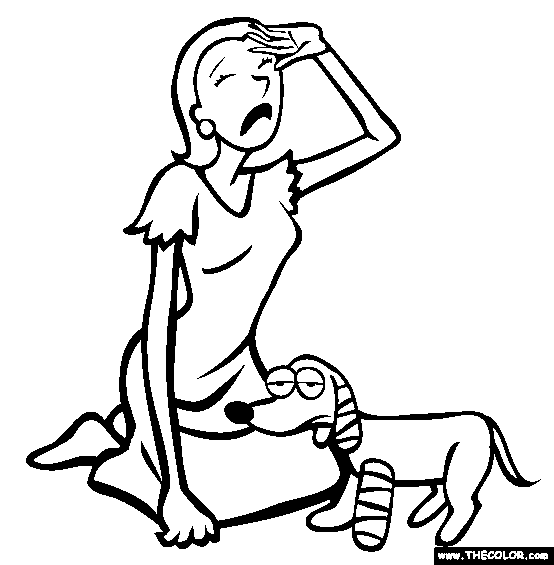
Whilst Stanislavsky was an actor he was always questioning how you could act, what is the meaning behind it? First of all he liked the idea of naturalistic acting which was a style of acting the people of his time were not used to. They were into the whole melodramatic type of drama, they "played" emotion instead of actually feeling it. For example if they received bad news they would throw their hands into the air and let out a big sigh. or place one hand on their forehead and let out a massive cry, like shown in the picture below. However nowadays its not about the biggest action on stage its about the naturalistic subtle actions that draw the audience in .
 Moving onto the "meaning" behind the acting, I think that whole idea is about the meaning in the text, the subtext of the play and most importantly your given circumstances. It is vital for the actors to understand the meaning behind the text otherwise they don't know what journey their character has been on, therefore they cannot play that character to the fullest potential. The given circumstances are all the questions you ask when you first might read a script e.g what time is it? who am I? do I have a family? what type of person am I? (also the vital thing in the given circumstances is to use the pronoun "I", this helps you to "be" the character)
 Next Looking at the Stanislavsky system, the system includes lots of ideas and theories mostly on how to access your creative will/ state and the physiological side of acting. He wanted actors to understand the life of the human spirit, how to just live breathe and be in the moment. He wanted the actors to be able to play a variety of characters and not just stick to one type. Which was very common in the 1800's, you would see an actor play the same type of role each time. This meant that actors didn't get the chance to explore playing other characters, which would be quite boring. If I had to play the same type of character each time I had to act I would feel restricted , and I would probably fall into a pattern of where I use the same tone for each emotion I had to play.
Today I learnt about the different types of actors; you have personality actors and character actors.
Personality actors is where you play yourself on stage an example would be: Robert Shaw
Often Cast As: An intelligent and hard nosed villain
And character actor is you play a character on stage; maybe an example would be Johnny Depp.
Another key word that I learnt today was emotional memory: its where you use your memory in order to evoke your emotion, I actually applied this to my performance workshop class. I got told that I had received bad news and I had to portray that through my improvisation task. I thought of the time when I found out that my nan passed away and that evoked my emotion, I felt hurt and Pain.
Overall at the end of the lesson we realized how all of modern day acting has the route of Stanislavsky's work. which includes everything from given circumstances, naturalistic acting and emotional memory. Without Stanislavsky and many other theatre practitioners the idea of naturalistic acting wouldn't have been introduced until a much later date or maybe even at all.
Today was my first lesson in language of theatre, I thought the lesson was going to be learning about different terms in theatre such as: proxemics or, given circumstances. However today was learning more about the Konstantin Stanislavsky book and Stanislavsky himself.
He was a Russian Theatre practitioner who revolutionised 21st century theatre. He was born into a wealthy Russian family in 1863 and was the second of nine siblings. Konstantin started the Moscow arts theatre company in 1898 alongside the playwright and director Vladimir Nemirovich-Danchenko.
Here is a video showing the outside of the Moscow arts theatre: https://youtu.be/OAopyJvq9T4
Whilst Stanislavsky was an actor he was always questioning how you could act, what is the meaning behind it? First of all he liked the idea of naturalistic acting which was a style of acting the people of his time were not used to. They were into the whole melodramatic type of drama, they "played" emotion instead of actually feeling it. For example if they received bad news they would throw their hands into the air and let out a big sigh. or place one hand on their forehead and let out a massive cry, like shown in the picture below. However nowadays its not about the biggest action on stage its about the naturalistic subtle actions that draw the audience in .
Today I learnt about the different types of actors; you have personality actors and character actors.
Personality actors is where you play yourself on stage an example would be: Robert Shaw
Often Cast As: An intelligent and hard nosed villain
And character actor is you play a character on stage; maybe an example would be Johnny Depp.
Another key word that I learnt today was emotional memory: its where you use your memory in order to evoke your emotion, I actually applied this to my performance workshop class. I got told that I had received bad news and I had to portray that through my improvisation task. I thought of the time when I found out that my nan passed away and that evoked my emotion, I felt hurt and Pain.
Overall at the end of the lesson we realized how all of modern day acting has the route of Stanislavsky's work. which includes everything from given circumstances, naturalistic acting and emotional memory. Without Stanislavsky and many other theatre practitioners the idea of naturalistic acting wouldn't have been introduced until a much later date or maybe even at all.
Subscribe to:
Posts (Atom)