Today was my first lesson in language of theatre, I thought the lesson was going to be learning about different terms in theatre such as: proxemics or, given circumstances. However today was learning more about the Konstantin Stanislavsky book and Stanislavsky himself.

He was a Russian Theatre practitioner who revolutionised 21st century theatre. He was born into a wealthy Russian family in 1863 and was the second of nine siblings. Konstantin started the Moscow arts theatre company in 1898 alongside the playwright and director Vladimir Nemirovich-Danchenko.
Here is a video showing the outside of the Moscow arts theatre: https://youtu.be/OAopyJvq9T4
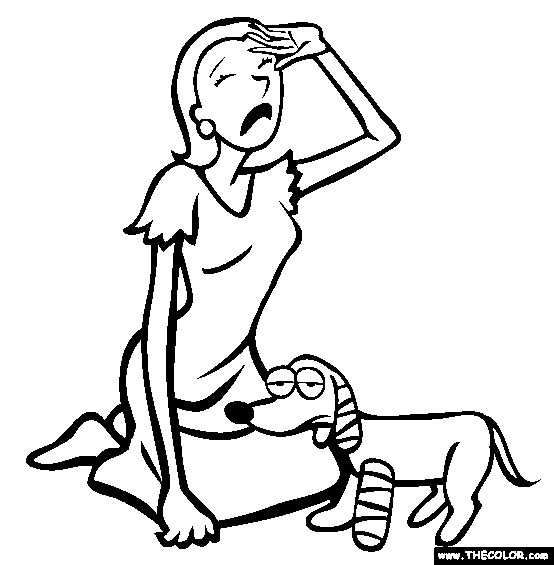
Whilst Stanislavsky was an actor he was always questioning how you could act, what is the meaning behind it? First of all he liked the idea of naturalistic acting which was a style of acting the people of his time were not used to. They were into the whole melodramatic type of drama, they "played" emotion instead of actually feeling it. For example if they received bad news they would throw their hands into the air and let out a big sigh. or place one hand on their forehead and let out a massive cry, like shown in the picture below. However nowadays its not about the biggest action on stage its about the naturalistic subtle actions that draw the audience in .

Today I learnt about the different types of actors; you have personality actors and character actors.
Personality actors is where you play yourself on stage an example would be: Robert Shaw

Often Cast As: An intelligent and hard nosed villain
And character actor is you play a character on stage; maybe an example would be Johnny Depp.
Another key word that I learnt today was emotional memory: its where you use your memory in order to evoke your emotion, I actually applied this to my performance workshop class. I got told that I had received bad news and I had to portray that through my improvisation task. I thought of the time when I found out that my nan passed away and that evoked my emotion, I felt hurt and Pain.
Overall at the end of the lesson we realized how all of modern day acting has the route of Stanislavsky's work. which includes everything from given circumstances, naturalistic acting and emotional memory. Without Stanislavsky and many other theatre practitioners the idea of naturalistic acting wouldn't have been introduced until a much later date or maybe even at all.

No comments:
Post a Comment